
Environmental Controls: Holding the Perfect Microclimate, Hour by Hour
Plants do not care about the weather outside. In a controlled-environment farm, the climate is whatever you make it — and holding it steady is the whole game.
1. The microclimate is the farm
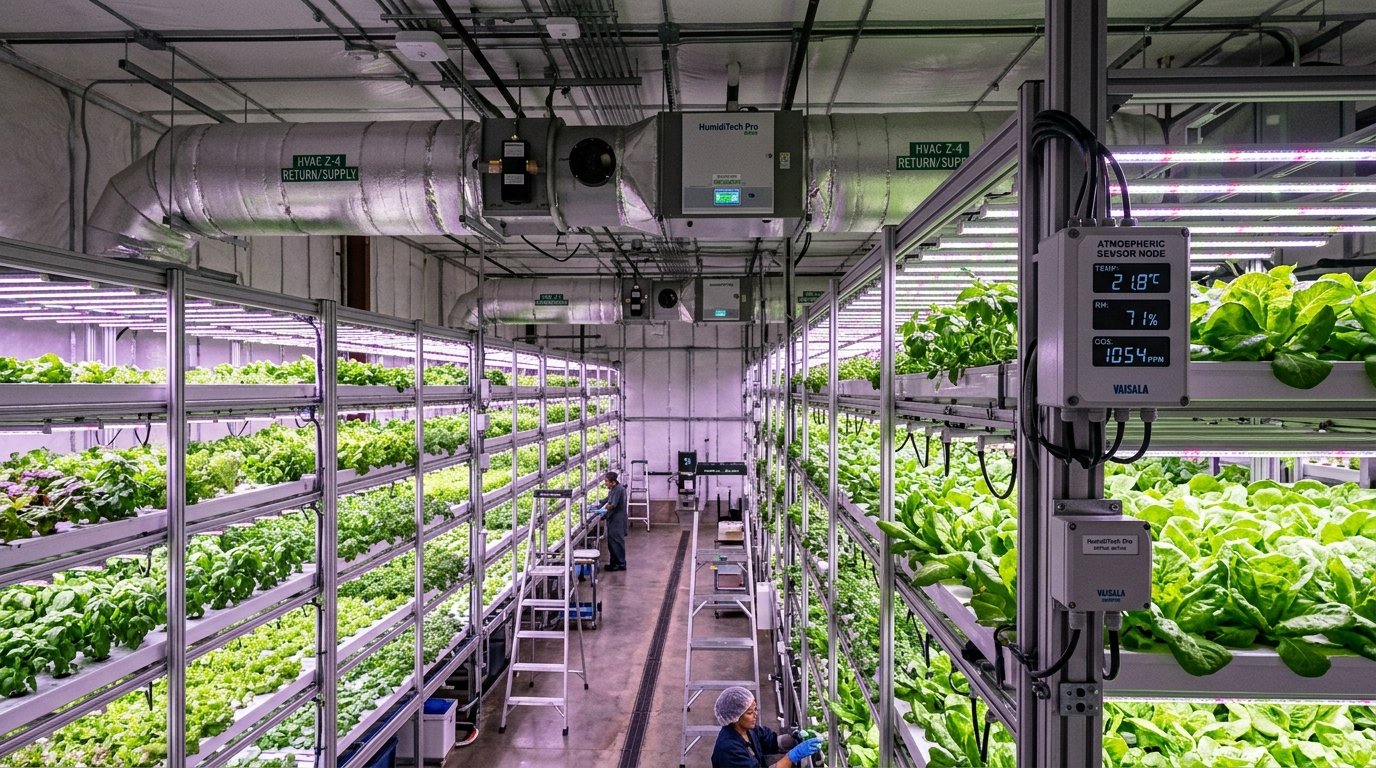
Ask a field farmer what determines their yield and they will talk about weather, soil, and season. Ask the operator of an indoor farm and the answer is simpler: the microclimate. In a sealed, lit, irrigated room, the climate is the environment. Everything else — the cultivar, the nutrients, the robots — is in service of it.
This is why environmental control is the heart of controlled-environment agriculture. It is also why it is hard. Holding a steady climate across hundreds of square metres of dense canopy, under the heat of high-intensity lighting and the transpiration of thousands of plants, is an engineering problem of the first order.
2. The six variables
Six parameters define a plant's aerial environment: light (intensity and spectrum), temperature, humidity, carbon dioxide concentration, airflow, and the root-zone environment (solution temperature and oxygenation). Each interacts with the others. Raise the light and the temperature rises; raise the temperature and the transpiration rate changes, which changes the humidity, which changes the dew point and the risk of condensation.
A good control system does not treat these as six independent dials. It treats them as a coupled system and adjusts them together.
3. Light: intensity and spectrum
Light is the energy source for everything that happens in the farm. Two attributes matter: how much (intensity, measured as PPFD) and what colour (spectrum). A leafy green wants moderate intensity and a balanced spectrum; a fruiting crop wants high intensity and a spectrum that shifts toward red during flowering. Our programmable LEDs let us tune both per zone and per growth stage.
Uniformity matters as much as level. A tier with bright spots and dark spots produces uneven growth, so we model light distribution across the canopy before installation to eliminate hotspots.
4. Temperature: stability beats perfection
Plants stress on swings, not just extremes. A climate that holds a steady 22°C will generally outperform one that averages 22°C but swings between 18 and 26. This is why our control target is not just the setpoint but the variance around it — holding temperature within half a degree across every zone.
The challenge is the heat load. High-intensity lighting dumps heat into the room, and the HVAC system must remove it continuously. Undersized cooling is the most common cause of temperature drift in a vertical farm, which is why we size climate systems to the lighting load, not just to the building.
A plant can tolerate a suboptimal average. It cannot tolerate a roller coaster. Stability is the climate's first job.
5. Humidity: the transpiration balance
Humidity is the variable most often underestimated. Plants transpire water through their leaves to pull nutrients up from the roots; if the air is too humid, transpiration stalls and nutrient uptake falls. If the air is too dry, the plant transpires too fast and stresses. The right humidity band depends on the crop and the temperature — warmer air can hold more moisture without causing condensation.
The hardest humidity problem is the dew point. If any surface in the room drops below the dew point, water condenses — on leaves, on racks, on sensors — and that water invites disease. Our dehumidification systems are sized to hold the room above the dew point under the full transpiration load.
6. CO2: the photosynthesis lever
Carbon dioxide is the raw material of photosynthesis. Ambient air is about 420 parts per million; enriching to around 1000 to 1200 ppm can meaningfully increase growth rate, particularly under high light. The catch is that enrichment only helps if everything else is in spec — light, temperature, and nutrients must all be sufficient for the plant to use the extra CO₂.
Our systems modulate CO₂ based on occupancy and photosynthetic activity rather than running it continuously, which is both more economical and safer.
7. Airflow: the forgotten variable
Airflow rarely gets the attention it deserves. Still air at the leaf surface creates a humid boundary layer that stifles transpiration and invites disease. Gentle, directional airflow across the canopy removes that boundary layer, strengthens stems, and distributes CO₂ evenly. Too much airflow, however, stresses the plant and dries the leaf. The right velocity is a Goldilocks problem, and it varies by crop and growth stage.
8. The control loop
All of these variables are held by a feedback loop: sensors read, the controller calculates the corrective action, actuators actuate, and the loop repeats every minute. The logic is proportional-integral-derivative (PID) control, tuned to the thermal mass of the facility so it neither overcorrects nor lags. Setpoints follow a recipe that changes with growth stage, and the machine-learning layer can recommend recipe adjustments based on observed plant response.
The result is a climate that is steady to a fraction of a degree and a few percent humidity, hour after hour, week after week. That stability is what makes the growth rates of indoor farming possible.
9. When things go wrong
A control failure in a dense farm can lose a crop in hours, so the system must fail safe. Sensors cross-validate; a single drifting sensor is flagged against its neighbours. Actuators default to safe states on communication loss. Critical loops have hardware backups independent of the software platform. And operators receive instant alerts on any out-of-tolerance condition, with a full audit trail of every setpoint change and actuation.
The principle is simple: the control system should be the most boring part of the farm. If it is doing its job, nothing exciting ever happens.
10. Why this matters
Environmental control is unglamorous, but it is the layer that makes everything else possible. The best cultivar, the best nutrients, and the best robots produce nothing in a climate that swings. When the climate is steady, every other layer of the farm can do its best work.
That is why we invest so heavily in it, and why it is the first thing we engineer on any new project. Get the microclimate right, and the rest follows.
See the systems
Our environmental controls service page covers how we deploy these systems in practice.
Related articles
 Vertical Farming Future
The Vertical Farming Future
Why stacked indoor farms are the next agricultural revolution.
 AI in Agriculture
AI in Agriculture
How AI is transforming the way we grow food.
 Crop Nutrition
Crop Nutrition Decoded
The science of feeding plants precisely what they need.
Need a climate system that holds steady?
Whether new-build or retrofit, we engineer control loops that keep your farm in spec.
Discuss your climate needs