
The Vertical Farming Future: Why Stacked Indoor Farms Are the Next Agricultural Revolution
For most of history, farming spread horizontally. The next chapter grows up, not out — and the economics are finally starting to make sense.

1. A short history of farming's direction
For ten thousand years, agriculture expanded across the surface of the earth. When land ran out, we cleared forest. When soil degraded, we moved on or applied more fertiliser. The frontier was always horizontal, and for most of that history, it was effectively infinite.
It no longer is. Arable land per person has been falling for decades, freshwater aquifers are shrinking, and the climate that made each region's agriculture possible is shifting. The horizontal frontier is closing. Vertical farming is one answer to the question that follows: where does the next calorie come from?
2. What vertical farming actually is
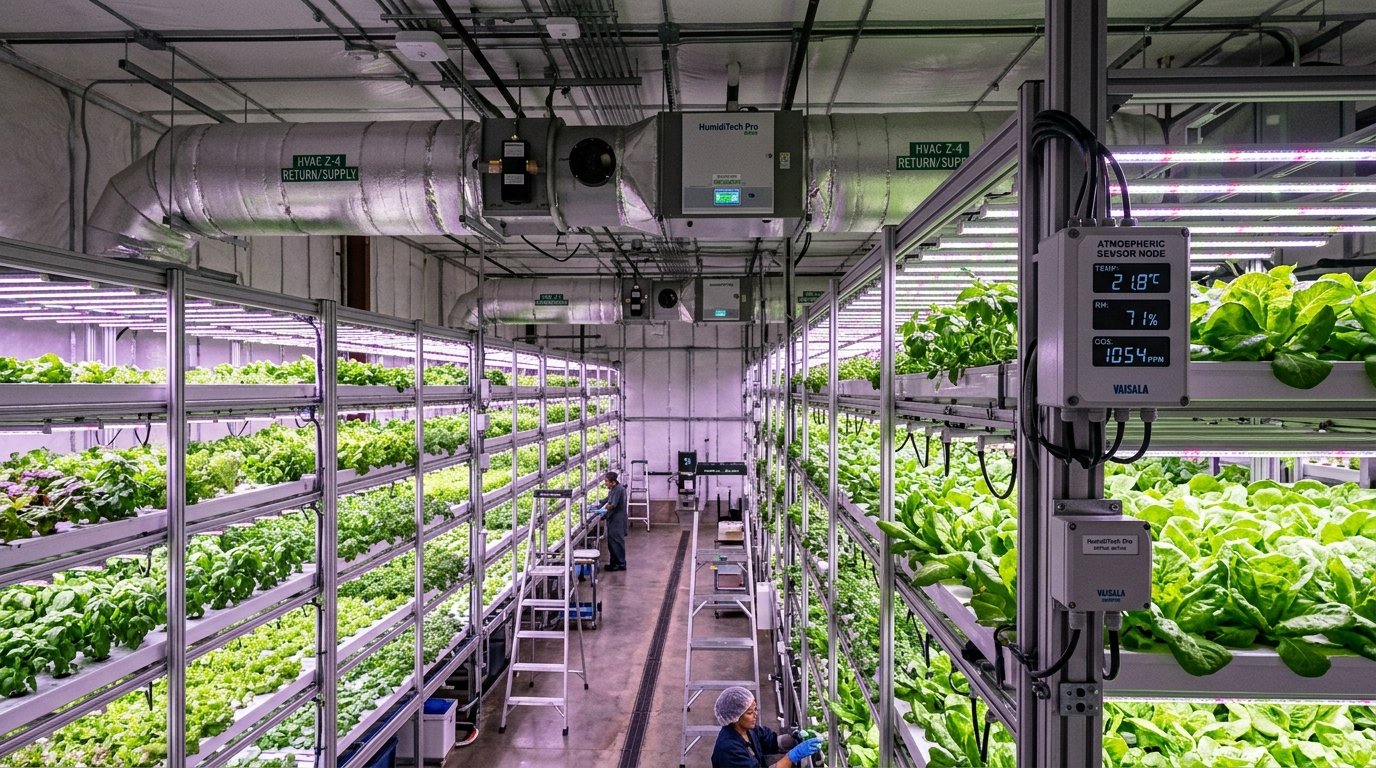
Vertical farming is the practice of growing crops in stacked layers inside a controlled environment, typically without soil, using artificial lighting and recirculating water. The defining feature is not the technology but the orientation: production volume scales with vertical space, not land area.
A single square metre of floor can host six, eight, or more tiers of growth, each producing at rates that dwarf field agriculture per unit of land. The trade-off is energy: instead of free sunlight, the farm pays for light. Whether the trade is worthwhile depends entirely on the value of the crop and the cost of the electricity.
3. The resource case
The numbers are striking. A well-run vertical farm uses roughly 95% less water than the equivalent field operation, because water is recirculated and only transpired water is replaced. It uses no arable soil, no pesticides, and produces no agricultural runoff. It can be sited in a warehouse, a basement, or a rooftop — anywhere with power and water.
For a planet where agriculture consumes about 70% of freshwater and occupies roughly half of habitable land, those numbers are not marginal. They are the difference between a food system that can fit within planetary boundaries and one that cannot.
4. The economic case
The economics of vertical farming have historically been its weakness. Lighting and climate control cost real money, and for low-value commodity crops, that cost is prohibitive. But three things have changed:
- LED efficiency has roughly doubled in a decade, and continues to improve.
- Automation has cut the labour component per kilogram dramatically.
- The premium for fresh, local, pesticide-free produce has risen as consumers and retailers care more about provenance.
The result is that for high-value crops — leafy greens, herbs, berries — vertical farming is now competitive with field-grown in many markets, and the trend line is moving in its favour.
5. Where vertical farms sit
The most powerful feature of vertical farming is location independence. A farm can sit inside or beside the city it feeds, cutting the supply chain from weeks to hours. That matters for three reasons: freshness, waste, and resilience.
Leafy greens lose nutritional value quickly after harvest; a farm across town delivers produce that is days, not weeks, old. Shorter chains also mean less cold-chain waste — a significant share of field produce is lost between farm and shelf. And a distributed network of urban farms is far more resilient to supply disruption than a centralised one.
6. The crops that work
Not every crop belongs in a vertical farm. The economics favour fast-growing, high-value, perishable produce: leafy greens, herbs, microgreens, and selected soft fruits. Staple crops like wheat or rice, which store well and sell cheaply, do not justify the energy cost today.
That is not a weakness; it is a sensible division of labour. Vertical farms should grow what they grow best — fresh, perishable, premium produce — while field agriculture focuses on the staples it handles efficiently. The two are complements, not competitors.
7. The energy question
The honest critique of vertical farming is energy. A field gets sunlight for free; a vertical farm pays for every photon. This is real, and it is the reason crop selection matters so much. But the comparison is more nuanced than it first appears.
Field agriculture also consumes energy — in diesel for tractors, in fertiliser production, in cold-chain logistics, in the embedded water of wasted produce. A full-system comparison often narrows the gap considerably, particularly when the vertical farm's electricity comes from renewables. As grids decarbonise, the carbon case for indoor farming improves every year.
The right question is not "does vertical farming use more energy than fields?" but "does it use less of the things we're running out of?" On water, land, and resilience, the answer is clearly yes.
8. Common misconceptions
A few myths are worth clearing up. Vertical farming is not "lab-grown" food; the plants are real plants, grown in real (if soil-less) conditions. It is not only for lettuce; herbs, microgreens, strawberries, and selected fruiting crops are all commercially grown indoors. And it is not a silver bullet — it is one valuable tool in a larger food-systems toolkit, not a replacement for all of field agriculture.
9. What changes in the next decade
Three trends will shape the next ten years. First, energy costs will keep falling as LEDs improve and renewables expand. Second, automation will deepen, with robots handling more of the physical work and AI more of the decision-making. Third, the data layer will mature, allowing farms to learn from each other and from shared models rather than each starting from scratch.
Together, these trends will push vertical farming from a niche for premium produce toward a mainstream source of fresh food for cities — not replacing fields, but sitting alongside them as a complementary production system.
10. Why this matters now
The case for vertical farming is not theoretical. It is being made, daily, by working farms supplying real produce to real buyers. The question is no longer whether the model works, but how quickly it scales and who builds the platform that scales it.
That is the work we are doing at Annadhara. If it interests you, we'd love to talk.
Explore the engineering
Our vertical farm design page walks through how these facilities are built.
Related articles
 Sustainable Food
Building Sustainable Food Systems
Designing supply chains that feed cities without draining the planet.
 Water Conservation
Water Conservation in Agriculture
How closed-loop farming saves the resource agriculture uses most.
 Environmental Controls
Environmental Controls
Holding the perfect microclimate, hour by hour.
Thinking about a vertical farm?
We design, build, and operate them. Tell us your site and goals and we'll model the possibilities.
Talk to our team