
Robotics in Farming: The Machines Quietly Taking Over the Repetitive Work of Agriculture
Farming has always been physical work. Increasingly, the most repetitive parts of it are done by machines that do not tire, do not vary, and do not take a day off.
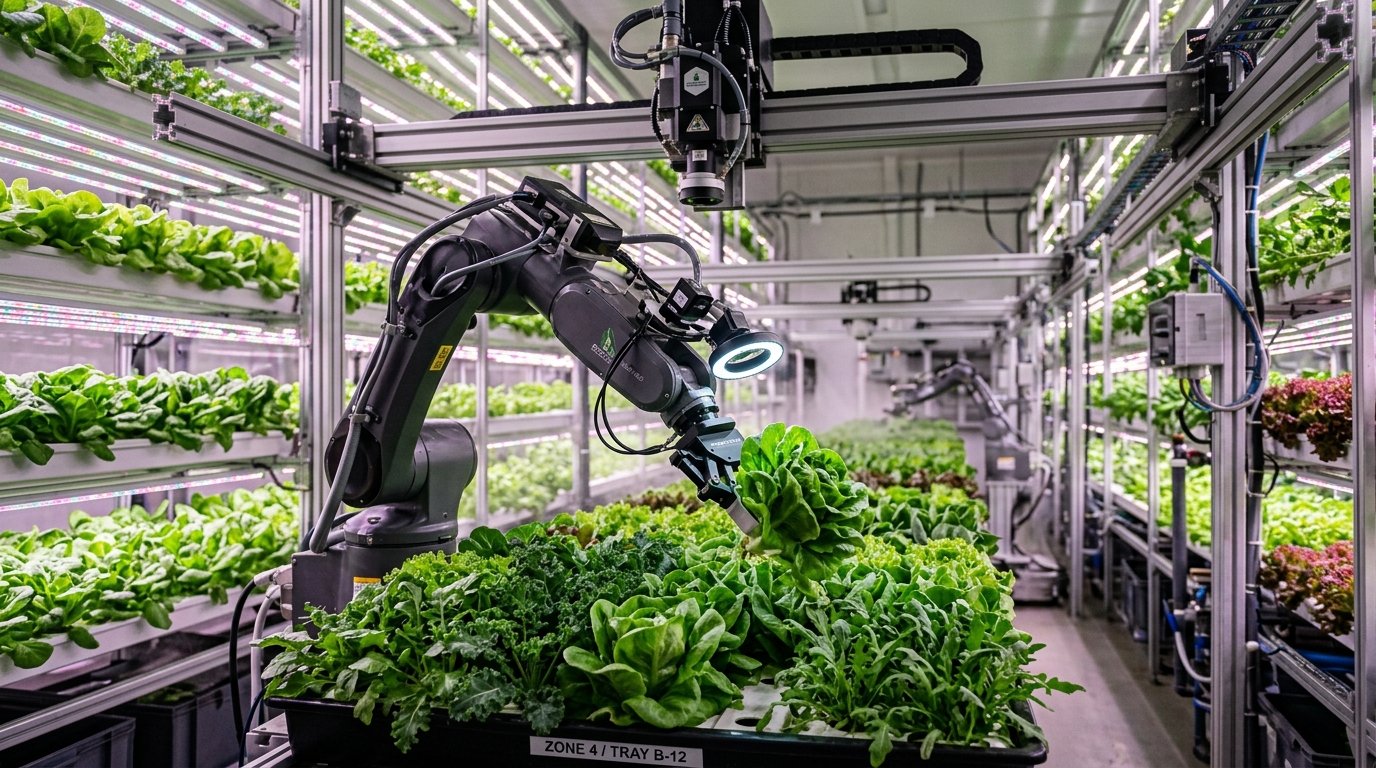
1. Why robots, why now
Robots have been on factory floors for decades, but agriculture resisted automation for a long time. The reasons are simple: fields are unstructured, crops are fragile and variable, and the cost of sensing and actuation was too high to justify for low-margin produce.
Two things changed. Indoor farming created a structured, repeatable environment where robots thrive. And the cost of cameras, actuators, and compute fell to the point where automating a tray of greens became economical. Together, these turned agriculture from a hard case for robotics into a good one.
2. The tasks robots do best
Not every farm task suits a robot. The best candidates share three traits: they are repetitive, physically demanding or tedious, and require consistency rather than judgement. Seeding, transplanting, tray moving, harvesting, and monitoring all fit. Crop planning, recipe design, and exception handling do not — those stay with people.
The principle is to free humans for the work that benefits from judgement, and let machines handle the work that suffers from fatigue.
3. Seeding and propagation
Seeding is the first task most farms automate, and for good reason. A precision seeder places individual seeds into substrate plugs at high speed, with verified placement and spacing. The result is uniform germination, easier handling downstream, and a dramatic reduction in the labour of the most tedious task on the farm.
Automated propagation also enables tighter scheduling. Because the seeder logs every plug, the system knows exactly what is in each tray and when it was sown — data that feeds the yield-forecasting models.
4. Transplanting and moving
Once seedlings are ready, they must move from propagation to grow trays. Done by hand, this is slow and risks root damage. Robotic transplanting arms lift seedlings by the plug, not the stem, and place them at precise spacing in the grow tray — faster, gentler, and more consistent than manual transfer.
Tray shuttles and conveyors then move trays between zones, routing each to the right environment for its stage. The platform orchestrates these moves based on crop status and downstream demand, so the right tray is always in the right place at the right time.
5. Harvesting with vision
Harvesting is the hardest task to automate and the most valuable to get right. Pick too early and you sacrifice yield; pick too late and you sacrifice shelf life. A human picker must make that judgement hundreds of times an hour, under time pressure, and quality drifts through a shift.
A vision-guided harvester makes the judgement consistently. Trained on thousands of images, the model assesses maturity from colour, size, and texture, then guides a soft gripper to harvest without bruising. The result is uniform quality, lower waste, and the ability to harvest through the night to meet morning delivery.
A robot does not have a bad day. It does not get tired at hour ten. It harvests the same way at 3am as it does at 3pm — and that consistency is worth more than speed.
6. Monitoring and inspection
Between seeding and harvest, crops need watching. Fixed cameras and autonomous monitoring drones patrol the aisles, capturing canopy images that feed the vision models for disease and stress detection. A human walking the aisles twice a day sees a sample; a monitoring system sees the whole farm, continuously.
This does not replace the human walk-through — an experienced operator still spots things a camera misses. But it does mean that by the time the operator arrives, the system has already flagged the zones that deserve attention.
7. What this means for labour
The fear that robots replace farm workers is largely misplaced in our context. What they replace is the most tedious, physically wearing part of the work. The people who used to seed and transplant move into oversight, crop science, maintenance, and logistics — generally higher-skill, better-paid roles.
In practice, our partner farms tend to employ the same number of people after automation as before, but in different roles. The total output rises, so labour cost per kilogram falls, but headcount often stays flat or even grows as the farm scales.
8. Safety and human-robot collaboration
Any robot that works near people must be safe. Our robots operate in zoned areas protected by light curtains and pressure mats; a human entering an active zone automatically pauses the robot. Critical systems fail safe, and every actuation is logged. Safety is not a feature added at the end; it is designed in from the first drawing.
9. The limits of today's robots
It is worth being honest about what robots still do poorly. Delicate fruiting crops with irregular ripening — a strawberry hidden under leaves, a tomato that must be picked without disturbing the vine — remain hard. Vision has improved enormously, but the dexterity of a human hand is still unmatched for the most awkward picks.
The state of the art is therefore a partnership: robots handle the high-volume, uniform tasks; people handle the fiddly, judgement-heavy ones. The division of labour is chosen to play to each's strengths.
10. Where robotics is heading
The next frontier is softer manipulation and richer sensing. Grippers that can handle a ripe strawberry without bruising, sensors that feel ripeness as well as see it, and models that generalise across cultivars rather than being retrained for each. Each of these is arriving, year by year.
The long-term picture is a farm where the physical work is fully automated and the human role is entirely cognitive: planning, judging, improving. We are not there yet, but the path is clear, and each generation of hardware moves further along it.
See it in practice
Our robotics service page covers how we deploy these systems on working farms.
Related articles
 AI in Agriculture
AI in Agriculture
How AI is transforming the way we grow food.
 Vertical Farming Future
The Vertical Farming Future
Why stacked indoor farms are the next agricultural revolution.
 Crop Nutrition
Crop Nutrition Decoded
The science of feeding plants precisely what they need.
Which tasks should you automate first?
We can audit your workflow and model the return on automating each repetitive task.
Request an automation study