
Building Sustainable Food Systems
Designing supply chains that feed cities without draining the planet — and why where you grow matters as much as how.

In this article
- What "sustainable food" actually means
- The three pressures to balance
- Water: the hidden cost of a salad
- Land: the opportunity cost of fields
- Food miles and the cold chain
- Waste: the silent drain
- Resilience as a sustainability metric
- The role of controlled environments
- Measuring, not assuming
- What a better system looks like
1. What "sustainable food" actually means
Sustainability is one of the most overused words in food marketing, which makes it easy to lose sight of what it should mean. A sustainable food system is one that can feed the people who depend on it, now and in the future, without degrading the resources it depends on — water, soil, energy, biodiversity, and climate. Everything else is a detail.
By that definition, most of our current food system is not sustainable. It feeds us today by drawing down the resources that should feed us tomorrow. The question is not whether to change it, but how.
2. The three pressures to balance
Any food system sits under three pressures: resource use, environmental impact, and resilience. A system that minimises resource use but collapses under a supply shock is not sustainable. A system that is resilient but drains aquifers is not sustainable. The work is to balance all three, not to optimise one at the expense of the others.
Controlled-environment agriculture is interesting precisely because it can move all three in the right direction at once — if it is designed and operated well. The "if" is where most of the effort goes.
3. Water: the hidden cost of a salad
A single kilogram of field-grown lettuce can require hundreds of litres of water when you account for irrigation, evaporation, and runoff. Most of that water never touches the plant; it is lost to the soil and the air. In a closed-loop vertical farm, the same kilogram might need ten to twenty litres, because water is recirculated and only what the plant transpires is replaced.
That is not a marginal improvement. It is a category change. And in a water-stressed country like India, where agriculture consumes the majority of freshwater, it is one of the strongest cases for indoor farming.
4. Land: the opportunity cost of fields
Land used for one crop is land unavailable for another use — whether that is a different crop, a forest, or a city. Conventional agriculture's footprint is enormous, and much of it is devoted to low-value produce that could be grown far more densely indoors.
Vertical farming does not eliminate the need for fields; staples like grains and pulses will continue to be field-grown. But by moving high-value, perishable produce indoors, it frees land for the uses that genuinely require it — or for rewilding and carbon sequestration.
5. Food miles and the cold chain
The journey from farm to shelf is itself a major source of waste and emissions. Leafy greens trucked across a continent spend days in cold storage, lose nutritional value, and a significant fraction never reach a plate at all. A farm inside the city it feeds turns that journey into hours.
Shorter supply chains mean fresher produce, less cold-chain energy, and less waste. They also mean a more transparent chain — a buyer can visit the farm their greens came from, which builds trust in a way no certification label can.
6. Waste: the silent drain
Roughly a third of the food produced globally is wasted, much of it between farm and consumer. Cold-chain losses, shelf-life expiry, and cosmetic rejection all take a toll. Each wasted kilogram carries the water, energy, and land that produced it — waste is an environmental problem, not just an economic one.
Indoor farms reduce waste at several points: predictable harvests mean less oversupply; short chains mean less spoilage in transit; and consistent quality means fewer cosmetic rejections. The cumulative effect is meaningful.
If food waste were a country, it would be the third-largest emitter of greenhouse gases after China and the United States. Cutting waste is cutting emissions.
7. Resilience as a sustainability metric
A food system that breaks under stress is not sustainable, however efficient it appears in normal times. The last few years have made the fragility of long, centralised supply chains painfully clear. A network of distributed indoor farms, each feeding its own region, is structurally more resilient — a disruption in one node does not collapse the whole.
Resilience deserves to be measured alongside water and energy. A farm that can produce through a drought, a flood, or a supply interruption is delivering a sustainability benefit that does not show up on a single-cycle carbon audit.
8. The role of controlled environments
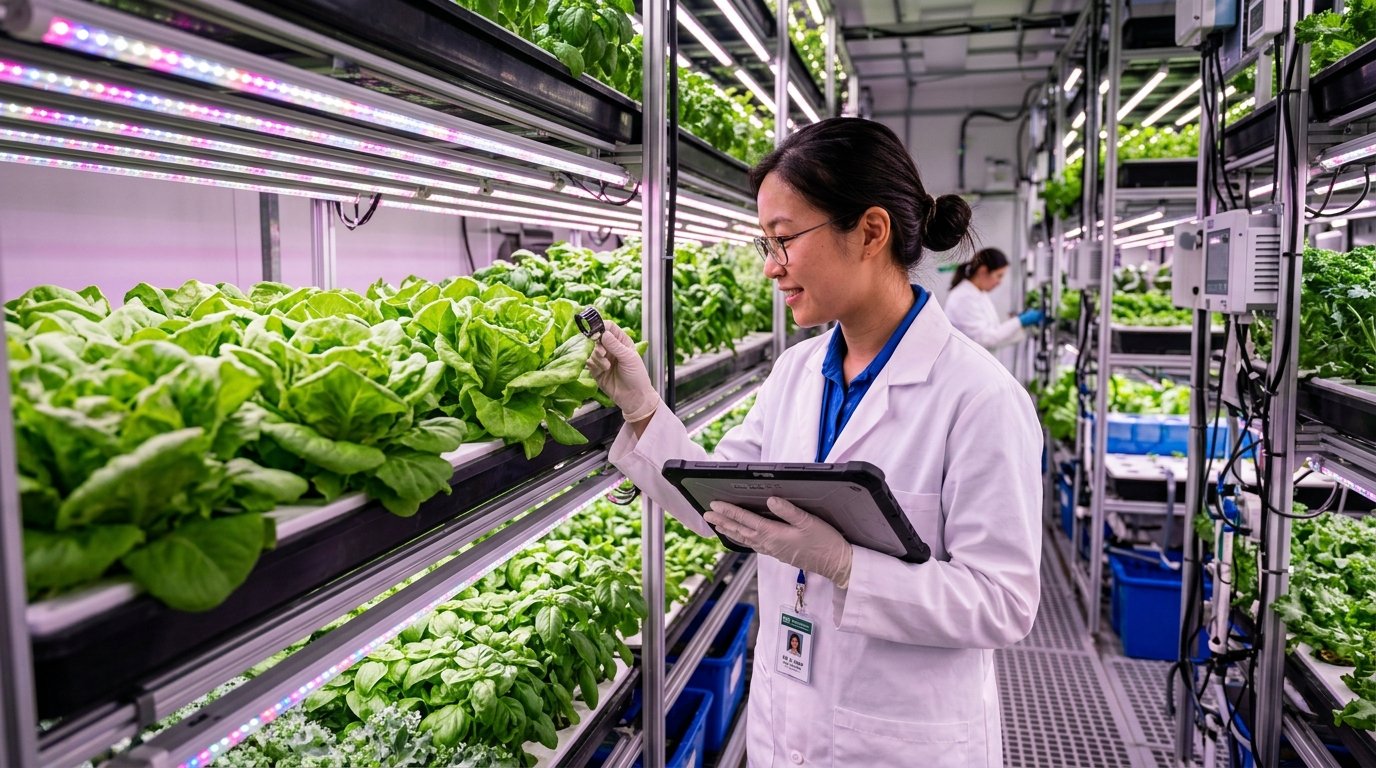
None of this means indoor farming is automatically sustainable. A poorly run vertical farm powered by coal and growing the wrong crops can be worse than the field it replaces. The point is that controlled environments make sustainability achievable, not that they guarantee it.
The discipline lies in crop selection (grow what is worth the energy), energy sourcing (prefer renewables), and system design (capture and reuse heat and water). Done well, the result is a food system that fits within planetary boundaries. Done badly, it is a costly experiment.
9. Measuring, not assuming
Sustainability claims are only credible if they are measured. We track water, energy, nutrient, and carbon intensity per kilogram of produce from every farm we operate, and we share those numbers with partners. An estimate is a guess; a measurement is a fact.
This is why our platform logs every input and output. It lets us, and our partners, report real sustainability metrics rather than industry averages. In a world increasingly sceptical of green marketing, audited numbers are the only durable currency.
10. What a better system looks like
A more sustainable food system is not a single thing. It is a patchwork: fields for staples, indoor farms for fresh produce, shorter chains between growers and eaters, and measurement holding all of it accountable. Vertical farming is one piece of that patchwork — a piece whose contribution grows as energy decarbonises and automation deepens.
The goal is not purity but progress: a system that feeds more people with less of what we're running out of. That is the standard we design to, and the standard we invite our partners to hold us to.
Want the numbers?
Our operations service includes the sustainability reporting we describe here.
Related articles
 Water Conservation
Water Conservation in Agriculture
How closed-loop farming saves the resource agriculture uses most.
 Vertical Farming Future
The Vertical Farming Future
Why stacked indoor farms are the next agricultural revolution.
 Crop Nutrition
Crop Nutrition Decoded
The science of feeding plants precisely what they need.
Want sustainability metrics you can audit?
Our operations service reports real water, energy, and carbon intensity per kilogram of produce.
Ask about reporting